

Today, Thai massage is known around the world as one of Thailand’s most distinctive wellness traditions. From quiet boutique spas in Bangkok to wellness retreats across the globe, the rhythmic movements, stretches and pressure techniques of Thai massage have become synonymous with relaxation, mobility and traditional Thai wellness.
But behind every modern Thai massage treatment lies a much older story.
Long before Thai massage became a popular spa experience, traditional healing knowledge was passed from generation to generation through communities, practitioners and temples. Its history is closely connected to Thai traditional medicine, Buddhist culture and the preservation of knowledge in historic temples.
The Roots of Thai Massage in Traditional Thai Medicine
Thai massage did not develop as an isolated technique. It forms part of a broader traditional Thai medical system that historically included herbal remedies, therapeutic practices and knowledge of the human body.
Traditional Thai medicine viewed health as a balance within the body and its relationship with the surrounding environment. Practitioners considered factors such as the elements, seasons, age, time and environment when understanding health and illness.
Within this tradition, massage became an important hands-on practice. Rather than simply focusing on relaxation, traditional massage was associated with maintaining physical balance, supporting movement and helping relieve discomfort.
This heritage helps explain why traditional Thai massage can feel very different from many Western-style massage treatments. Instead of relying exclusively on oils and continuous kneading, traditional Thai massage may combine pressure, stretching, compression and carefully controlled movement.
From Ancient Knowledge to the Temples of Bangkok
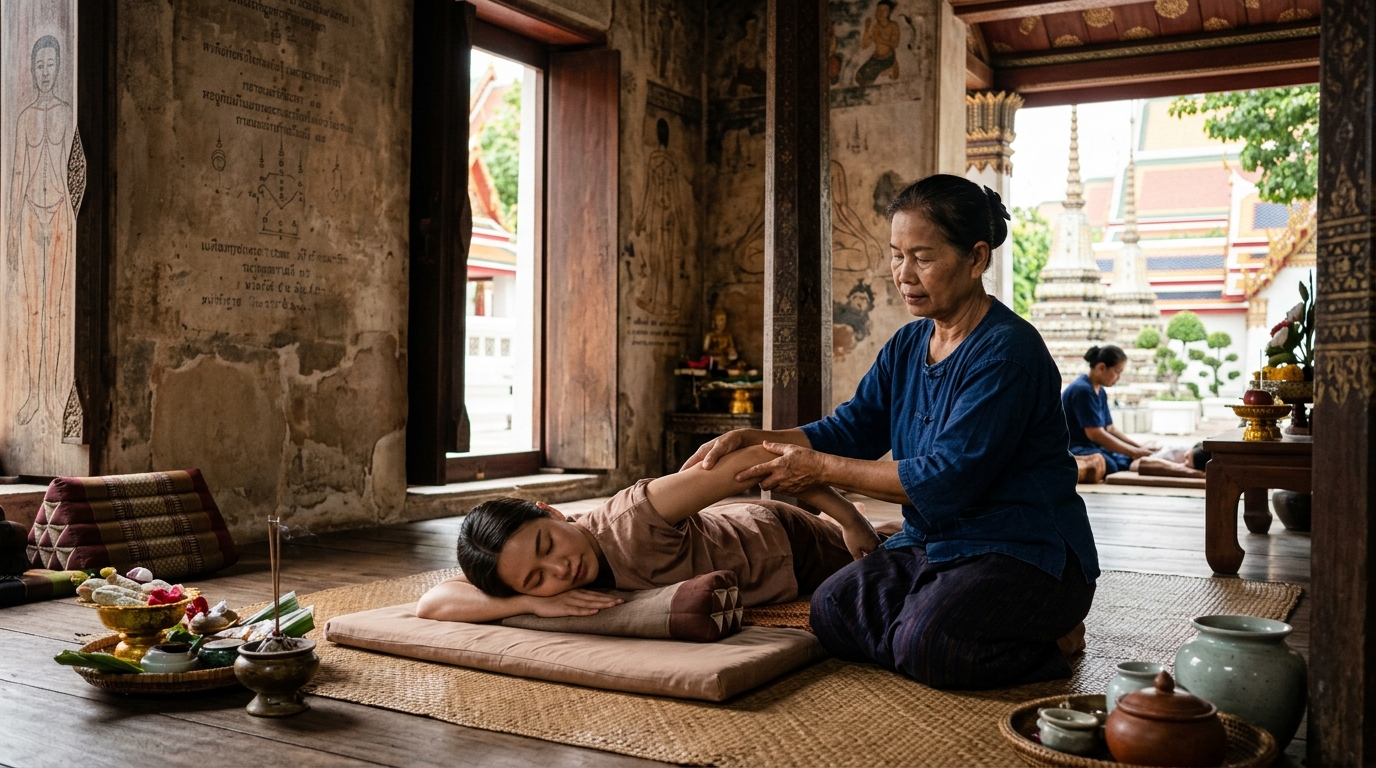
One of the most important places in the history of Thai massage is Wat Phra Chetuphon Wimon Mangkhalaram, better known as Wat Pho, in Bangkok.
Wat Pho is much more than a famous temple and tourist landmark. Historically, it became an important centre for preserving and sharing Thai knowledge. During the Rattanakosin period, Thai traditional medical knowledge was collected, examined and recorded at the temple.
Under King Rama I, traditional medical knowledge was among the subjects preserved at Wat Pho. Later, during the reign of King Rama III, scholars and experts were instructed to collect, verify and inscribe knowledge in different fields so that it could be studied by the wider public.
This idea of making knowledge accessible is central to Wat Pho’s legacy. The temple became associated with Thai arts, literature, medicine and other forms of traditional knowledge, earning a reputation as a centre of learning.
The Massage Inscriptions at Wat Pho
Visitors walking through Wat Pho today can still see evidence of this remarkable history.
Within the temple complex, inscriptions relating to traditional Thai massage were preserved alongside illustrations demonstrating massage positions. Wat Pho identifies a northern Sala Rai pavilion as a library of traditional Thai massage inscriptions, including 32 drawings of massage positions displayed around the pavilion.
These inscriptions represent an important attempt to preserve knowledge that had previously been transmitted through teachers and practitioners. Recording the knowledge in a public setting helped ensure that it could be studied and passed on to future generations.
For this reason, Wat Pho is often associated with the development and formal preservation of Thai massage knowledge. Its significance is not simply that massage was practised there, but that traditional knowledge was documented, taught and maintained as part of a wider Thai medical tradition.
Ruesi Dat Ton: The Art of Self-Stretching
Another fascinating part of Wat Pho’s wellness heritage is Ruesi Dat Ton, traditionally translated as the hermit’s self-stretching exercises.
The practice involves a series of body movements and postures designed to encourage stretching, movement and physical well-being. Historical records at Wat Pho associate the preservation of these exercises with the early Rattanakosin period.
Ruesi Dat Ton reflects an important principle found throughout traditional Thai wellness: the body is not simply something to relax, but something to move, stretch and care for.
This philosophy can still be felt in modern Thai massage, where the practitioner may guide the guest through passive stretches and movements rather than simply applying pressure to the muscles.
How Thai Massage Became a Profession
As Thai traditional medicine developed, massage knowledge became increasingly organised and formalised.
Wat Pho eventually became home to a traditional medical and massage school. According to Wat Pho, its traditional medical and massage school was established in the mid-20th century, helping create a structured environment where Thai traditional medicine and massage could be taught.
This transition was significant. Knowledge that had once been passed primarily through traditional communities and individual teachers increasingly entered an educational setting.
Students could learn established techniques, study traditional principles and practise under instruction. In this way, Thai massage moved from a largely inherited tradition toward a recognised system of education and professional practice.
From Temple Courtyards to Modern Treatment Rooms
The modern spa has transformed the environment in which Thai massage is experienced, but many of its fundamental characteristics remain recognisable.
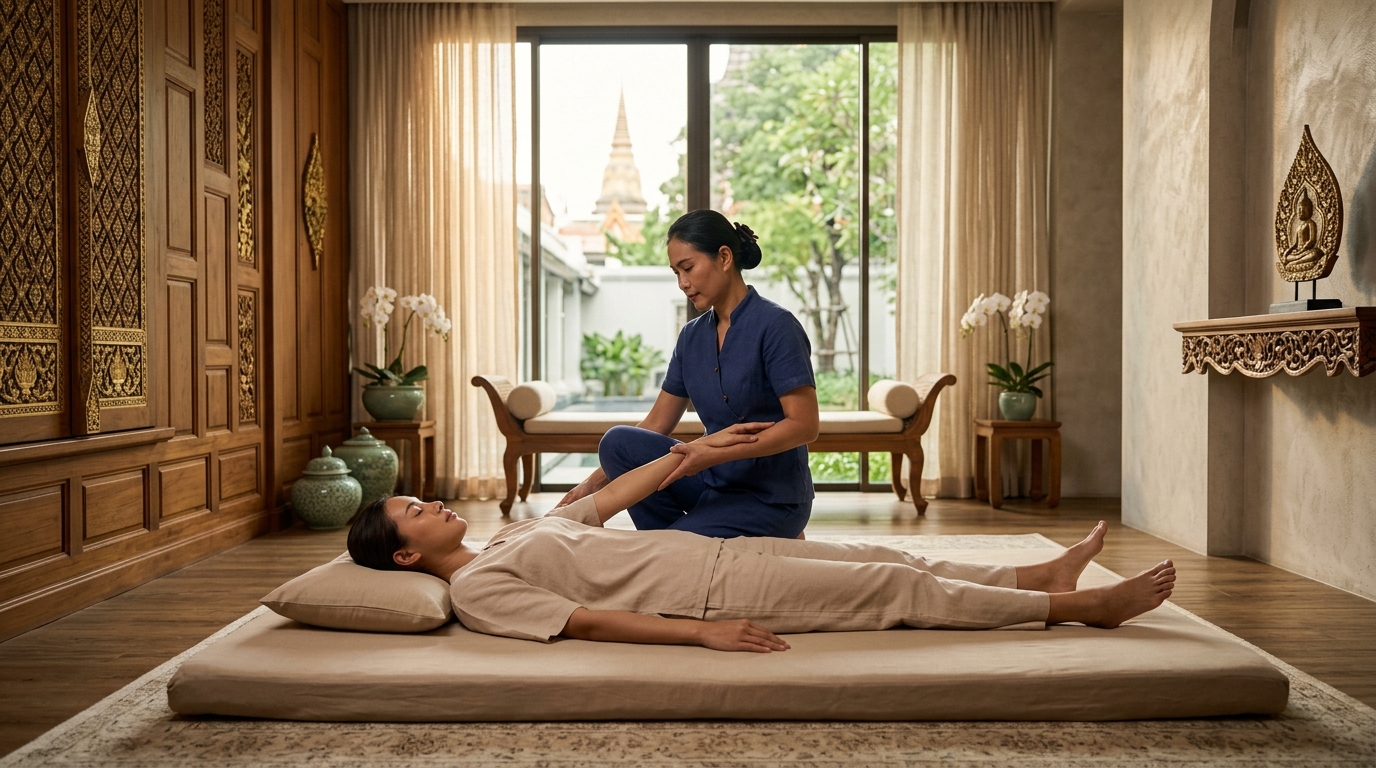
In a contemporary Bangkok spa, guests may enter a peaceful treatment room with soft lighting, calming music and a carefully designed atmosphere. Yet the treatment itself can still reflect principles that have been part of Thai massage for generations.
The practitioner may use palms, thumbs, elbows, forearms or feet to apply pressure. Gentle compression can be combined with assisted stretching and rhythmic movements. The sequence may move throughout the body rather than concentrating on a single muscle group.
The result is a treatment that can feel both grounding and dynamic.
This is one of the reasons Thai massage continues to stand apart from many other massage traditions. It is not simply about lying still while receiving a massage. Depending on the style and treatment, the guest can become part of the movement through guided stretches and passive postures.
The Bangkok Connection
For visitors discovering Thai massage for the first time, Bangkok offers a unique opportunity to experience both sides of its heritage.
The city combines historic temples, traditional medicine, contemporary wellness centres and luxury spas within the same urban landscape. A journey through Bangkok can therefore reveal how an ancient healing tradition continues to evolve without losing its cultural identity.
Walking through a historic temple such as Wat Pho provides a glimpse into the preservation of traditional knowledge. Experiencing Thai massage in a modern spa provides another perspective: the same cultural heritage adapted to the expectations of today’s wellness traveller.
For Bangkok’s spa culture, this connection between history and modernity is particularly meaningful. A treatment room may look contemporary, but the techniques being practised can carry generations of knowledge behind them.
Thai Massage as More Than Relaxation
One of the most interesting aspects of Thai massage is the way it combines relaxation with movement.
Traditional Thai massage can involve sustained pressure, rhythmic compression and assisted stretching. This creates an experience that many guests describe as both relaxing and revitalising.
Its holistic character also reflects the broader philosophy of traditional Thai wellness. Rather than treating relaxation as completely separate from physical movement, Thai massage brings the two together.
For modern spa guests, this can make the experience feel different from a conventional relaxation massage. After a treatment, the body may feel lighter and more mobile, while the mind has had an opportunity to slow down.
Why Thai Massage Remains Relevant Today
Wellness has changed dramatically in recent decades. Modern guests are increasingly interested in experiences that combine relaxation, physical well-being and cultural authenticity.
Thai massage naturally fits this movement.
Its history gives the treatment a depth that goes beyond the spa environment. Every stretch, compression and rhythmic movement can be understood as part of a tradition that has been preserved, taught and adapted over generations.
At the same time, contemporary practitioners can adapt treatments to different guests, lifestyles and comfort levels. Thai massage can therefore exist comfortably within both traditional and modern wellness environments.
Experiencing the Tradition in Bangkok
Understanding the history of Thai massage can change the way you experience it.
Instead of seeing the treatment simply as another spa service, you begin to recognise the cultural story behind it: traditional medicine, Buddhist temples, teachers, students, preserved inscriptions and generations of practitioners.
From the stone inscriptions of Wat Pho to the peaceful treatment rooms of Bangkok’s modern spas, Thai massage represents a fascinating journey from heritage to contemporary wellness.
And perhaps that is what makes the experience so distinctive. When you receive a Thai massage in Bangkok, you are not only experiencing a popular wellness treatment. You are encountering a living tradition that continues to connect Thailand’s past with its present.
Discover the Story Behind Thai Wellness
Thai massage has travelled far beyond Thailand, but its roots remain deeply connected to the country’s history and cultural heritage.
From temple courtyards and traditional medical texts to today’s sophisticated Bangkok spas, its journey demonstrates how ancient knowledge can evolve while retaining its identity.
For anyone visiting Bangkok, experiencing Thai massage is therefore more than an opportunity to relax. It is a chance to discover one of Thailand’s most enduring wellness traditions—one that has travelled from temples to treatment rooms and continues to be passed from one generation to the next.